
1. Translation
(1)Training Objectives
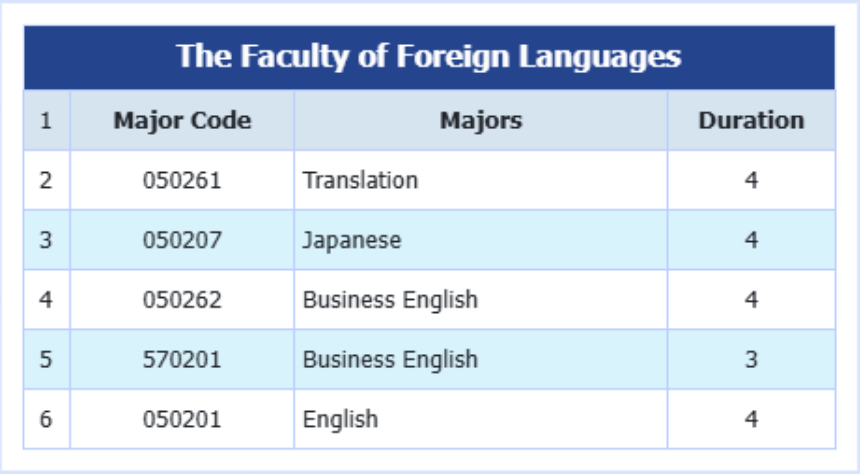
Centering on English Language and Literature as well as applied translation (interpreting and written translation), this program has established a curriculum system for cultivating interdisciplinary and application-oriented translation professionals. In 2009, the Department of Foreign Languages launched the English (Interpreting) concentration, making it the first department in Henan Province to offer this concentration. The English (Written Translation) concentration was set up in 2015, further improving the system for translation teaching and program development. In 2017, the interpreting and written-translation concentrations were officially separated to form the independent Translation major, opening a new chapter in its construction and development within the Faculty of Foreign Languages.
Every year, enrolled students obtain the CATTI Level 2 and Level 3 Professional Qualification Certificates for Written Translation. Students have won more than 60 awards in national and provincial level competitions including the National Interpreting Contest, the FLTRP National Foreign Language Competition (Interpreting and Written Translation events), and the Cross-Strait Interpreting Contest, covering Provincial First Prizes and National Second Prizes. The graduate employment rate has remained above 95%. Graduates mainly work for Xinhua News Agency, overseas departments and localization divisions of multinational enterprises, and overseas Confucius Institutes. Some pursue Master’s degrees in Translation and Doctoral degrees in Education at prestigious domestic and international universities such as Guangdong University of Foreign Studies, China Foreign Affairs University, and Renmin University of China. In 2021, the Translation major was accredited as a Key Project for the Construction of Provincial Master’s Degree-Granting Units by the Henan Provincial Department of Education, entering a phase of rapid development.
Focusing on national translation capacity building, responding to national and local socioeconomic needs, and leveraging the university’s strengths in economics, trade and management, the major caters to the demands of foreign-related economic-trade and cultural exchanges in the new era. It cultivates high-caliber application-oriented talents who master interdisciplinary theories and knowledge in translation studies, linguistics, intercultural communication, international communication, and area studies. Graduates are equipped with bilingual English-Chinese proficiency, information-technology literacy, practical bilingual interpreting and translation capabilities, and intercultural communication competence. They boast sound professional ethics for translation, humanistic attainments and global vision. Proficient in translation skills and modern information technologies, they are competent for careers in translation, foreign affairs, communication, foreign trade, English education and other relevant fields.
(2)Core Curriculum System
Core Courses: Advanced English Writing, English-Chinese Translation, Chinese-English Translation, Basic Interpreting, Consecutive Interpreting, Translation Technology, Intercultural Communication, An Introduction to Chinese Culture
Distinctive Practical Courses: English Phonetics, Translation and International Communication, Audiovisual Translation, News Compilation and Translation, Introduction to Translation, Comprehensive Training in Written Translation, Comprehensive Training in Interpreting, Comprehensive Training in English Audio-Visual-Oral Skills, Comprehensive Training in English Phonetics, AI-Assisted Translation and Post-Editing, Large-Language-Model-Empowered Localization Project Workshop
(3)Features of Practical Teaching
All faculty members of the major hold a Master’s degree or above; 50% have overseas study experience, and all possess CATTI Level 2 or higher professional qualifications in interpreting and written translation. In the past five years, they have provided interpreting and translation services for nearly 100 international conferences and foreign-affairs events in Henan Province. A Simultaneous-Interpreting Laboratory and a Computer-Aided Translation Laboratory have been built. Focusing on dual core competencies of “written translation + interpreting”, the major offers distinctive cutting-edge courses and adopts a three-in-one talent-training model of “Theory + Skills + Industry” to meet the demand for new-era translation professionals under China’s Going-Global Strategy.
2.Japanese
(1)Training Objectives
This major fosters well-rounded high-caliber application-oriented Japanese talents with sound moral, intellectual, physical, aesthetic and labor development. Students acquire fundamental theories of Japanese studies and basic knowledge of Japanese language and culture. They develop solid comprehensive Japanese proficiency, intercultural communication competence, and certain practical expertise in business or teaching. Graduates are qualified for jobs in cross-border e-commerce, teaching, translation, cultural exchange and other positions in commerce, education, foreign affairs and cultural sectors.
(2)Core Curriculum System
Basic Japanese, Advanced Japanese, Spoken Japanese, Japanese Audio-Visual-Oral Practice, Japanese Reading, Basic Japanese Writing, Japanese-Chinese Translation, Chinese-Japanese Translation, Practical Training in Japanese Interpreting, An Outline of Japan, Intercultural Communication, Understanding Contemporary China — Japanese Speeches and Debates, Japanese Linguistics, Academic Writing and Research Methods, Business Japanese Correspondence, Spoken Business Japanese
(3)Features of Practical Teaching
Relying on on-campus practical courses and various professional competitions, the major integrates specialized education, general education, innovation and entrepreneurship education to boost high-quality talent training. It hosts Henan’s first Japanese Culture Room, which integrates functions for cultural experience, Japanese communication and multimedia teaching, enabling students to experience authentic Japanese culture without going abroad.
3.Business English
(1)Training Objectives
Originating from the English (Commercial English) major established at the university’s founding in 1994, Business English (Undergraduate) has a 31-year history. Independent undergraduate enrollment for this major at the Faculty of Foreign Languages of Zhengzhou Shengda University began in September 2017. It currently has 377 full-time undergraduate students.
Following the Party’s educational policy, staying committed to fostering talents for the Party and the nation, and implementing the fundamental task of fostering virtue through education, the major serves national and local socioeconomic development needs. It nurtures well-rounded high-caliber application-oriented talents with sound moral, intellectual, physical, aesthetic and labor development. Graduates master basic theories and knowledge of linguistics, economics, management and law. They possess strong English competence, practical skills in international business, cross-border e-commerce platform operation capabilities and intercultural communication skills. They are competent for roles in import-export trade, cross-border e-commerce, business translation, business English training, business administration and other fields of foreign trade and foreign affairs.
(2)Core Curriculum System
Mandatory core courses include Introduction to Business Studies, Intercultural Business Communication, Business English Writing, International Trade Practices, Business English Translation, English Linguistics, and Research Methods and Academic Writing. Directional courses targeting international trade and cross-border e-commerce platform operation cover Spoken Business English, Fundamentals of Economics, International Business Negotiation, International Marketing, and Practices of Cross-Border E-Commerce Import and Export. Elective courses such as International Commercial Law, Foreign-Trade Document Practices, Business Data Analysis, AI + Business English Translation Workshop, Digital Business English Writing Bootcamp, and Cross-Border E-Commerce Live-Streaming and Short-Video Operation cater to diverse demands for further study and employment.
(3)Features of Practical Teaching
Adhering to the “English + Business” philosophy for interdisciplinary application-oriented talent cultivation, the major relies on practical-training platforms to integrate industry and education and build a university-enterprise community of shared values. In collaboration with partner enterprises, it has developed entrepreneurship-guidance courses delivered by corporate executives on campus, realizing innovative integration of learning and practice. It aims to cultivate high-caliber application-oriented international business talents who can meet socioeconomic and industrial development requirements.
4.Business English
(1)Training Objectives
Originating from the English (Commercial English) major founded at the university’s establishment in 1994, Business English (Junior College) has a 31-year history. As of 2025, it has 102 junior-college students across the Longhu Campus and Dengfeng Campus. Graduates are mainly employed by foreign-trade companies, economic-trade and foreign-affairs departments of public institutions, as well as educational organizations and training institutions including universities. They are widely recognized by society for their solid linguistic foundation and professional competence. Benefiting from Zhengzhou’s implementation of ten national strategies in recent years, the local demand for interdisciplinary and application-oriented English talents has surged, creating broad local job prospects for graduates. The major also achieves promising results in the college-to-undergraduate upgrade examination, with an admission rate reaching 44% in the past two years.
Upholding the mission of cultivating talents for the Party and the nation, the major develops high-caliber technical-skilled talents with firm political convictions and all-round development in morality, intellect, physical fitness, aesthetics and labor. Students attain certain scientific and cultural literacy, sound humanistic qualities, professional ethics, innovative awareness and the spirit of striving for excellence. They possess strong employability and sustainable development capabilities. Mastering English language knowledge plus professional expertise in economics and business, as well as technical skills in intercultural business communication and business practice, graduates serve job clusters such as international-business practitioners, business translators and business assistants. They are qualified for import-export business and business English interpreting and translation posts.
(2)Core Curriculum System
Courses include Comprehensive Business English, Spoken Business English, Intercultural Business Communication, Business English Writing, International Trade Practices, Business English Translation, International Business Negotiation, International Marketing, Comprehensive Practical Training in Foreign-Trade Business, and Cross-Border E-Commerce, satisfying students’ diverse needs for further education and employment.
(3)Features of Practical Teaching
Following the “English + Business” approach for interdisciplinary application-oriented talent training, the major leverages practical-training platforms to promote industry-education integration and build a university-enterprise community of shared interests. It co-develops entrepreneurship-guidance courses with partner enterprises, with corporate executives delivering on-campus lectures to achieve innovative integration of learning and practice. It strives to cultivate high-caliber application-oriented talents adaptable to socioeconomic and industrial development.
5.English
(1)Training Objectives
Launched in 1994, English is among the first six undergraduate majors offered by the university. It was designated as a Brand Major for Private Institutions of Higher Education in Henan Province by the Henan Provincial Department of Education in 2017. In 2018, its Foreign-Language Training Center was recognized as a Model Practical-Training Center for local universities in Zhengzhou. English Language and Literature was accredited as the Third-Batch University-Level Key Discipline in 2019. In 2021, the major won funding under the Henan Provincial Discipline-Construction Support Project for Private Universities. English Language and Literature was listed as the Fourth-Batch University-Level Key Discipline in 2022. In 2024, it was approved as a University-Level First-Class Program Construction Site.
Prioritizing service for regional economic development and targeting high-caliber application-oriented English talents, the major sets concentrations rationally to foster “English + Education” interdisciplinary talents based on the faculty’s realities and industrial demands. It cultivates high-caliber application-oriented English talents with outstanding humanistic attainments, proficient English skills and intercultural communication competence for careers in English teaching, translation, foreign-affairs services and other relevant fields.
(2)Core Curriculum System
The curriculum consists of five platforms: General Education, Discipline-Oriented Basic Education, Specialized Education, Practical Education, and Personalized Development Education. The Discipline-Oriented Basic Education platform focuses on comprehensive improvement of students’ English listening, speaking, reading and writing skills. The Specialized Education platform offers courses such as Intercultural Communication, Teaching Methodology, and Educational Psychology to enhance students’ intercultural competence and teaching theories and skills. The Practical and Personalized Development Education platform includes English-teaching-skill competitions and innovation-entrepreneurship courses to strengthen students’ overall competitiveness.
(3)Features of Practical Teaching
A multi-dimensional platform integrating “in-class practical training + on-campus competitions + social practice” has been built to enhance practical capabilities in all respects. First, professional competitions serve as guidance. Every year, the major hosts English-speaking contests, English short-video competitions and English-teaching-skill contests to create an atmosphere of professional competition, improving teaching skills and language expression through competition-driven practice. Second, the second classroom provides supplementary training. Social practices such as English volunteer teaching are organized to translate professional competence into social-service value. Students are encouraged to take part in innovation-entrepreneurship contests including the “Internet Plus” Competition and the “Challenge Cup” to develop innovative mindsets for education. Third, research and practice are integrated. Students are recruited into faculty research teams to participate in educational surveys and English-teaching-reform projects. This realizes industry-university-research-application integration and research-oriented education to boost students’ educational research capabilities.
T.+86 371-62436336 | F.+86 371-62577766
Address: Zhengzhou Shengda University, No.1 Wenchang Road, Longhu Town, Xinzheng, Zhengzhou, Henan 451191, China

郑公备:41018429000009 | 豫ICP备18042129号-1 | 前置备案20110100100272号

